Maybe I’m still too human. I resist viewing the many available web pictures of death in Lebanon and Israel in the recent carnage – even as my head tells me I must. As noted here before, the American viewing public had a profoundly sanitized version of the Israeli pounding of Lebanon, while the rest of the world witnessed a steady horrific stream of Lebanese civilian corpses, like the 3 dozen or so children who perished (again) at Qana.
My hesitance stems from analytical awareness of the power of such images to change thinking, unfairly at times, if we do not know the context of a sensational picture. Inevitably, images can be powerful tools, for good or ill, shaping international opinion of a given event. Contrary to Tony Cordesman, that’s why “smart” combatants today energetically endeavor to promote, repress, or sugar coat horrific images to suit their side’s agenda.
Never mind the cerebral level, the pictures from the past six weeks in Lebanon remain – a testament powerfully tugging at the heart and soul, for those with the courage to look. Such a waste!
Yet it wasn’t images of carnage that awoke me last night – like Jefferson’s “firebell in the night.” Instead, I am especially haunted by the memory of very different type of photo that I first saw here and then here.
No, they are not of dead children soaked in blood or caked in chemical ash, and they’re not the images of the broken “ragdoll” bodies of someone’s now departed, beloved child.
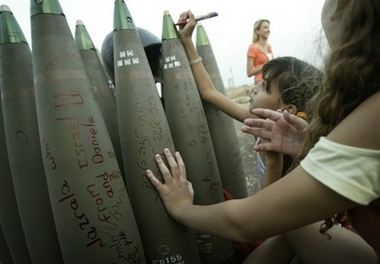
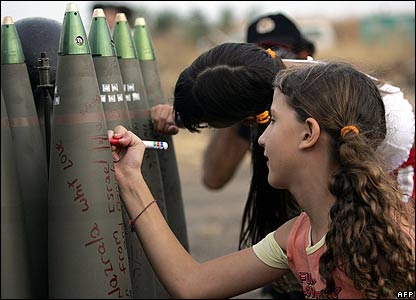
The pictures that eat at me even worse than the sight of death are of otherwise cherubic Israeli children writing messages and drawing images on Israeli shells bound for Lebanon.
One side of me still wanted to believe that there has to be an explanation, that these have to be doctored, or even fabricated, or explained away. I wish.
From the checking I’ve done, the photos are indeed legitimate, and different versions of the same scene apparently were taken by different photo services (AP, AFP, Ha’aretz, etc.) on July 17th.
While I am far better at searching for texts and documents via venerable tools like Nexus and Dow, I have a hunch that the original publisher/owners of these photos are shy, at best, about these photos, as I’ve encountered several no longer functioning photo links. Yet I am also learning that several reputable photo web site blogs have featured the photos and now store them in “permanent” links, such as via “Flikr.” See here, here, and here.
I’ve read claims that these photos have been the focus of scores (or more) of blog write-ups. However, it is my sense that the US mainstream media, TV and print, has generally ignored the photos. (Readers please chime in if you have any examples to the contrary.)
Responding to an internet buzz about the photos, no less than the Jerusalem Post (on-line only) on July 23rd sourced Israeli officials to confirm that the “graffitti incident” really did occur, that the photos were of an actual event. Indeed, the Associated Press photos were apparently taken by an Israeli photojournalist, Sebastian Scheiner.
According to the Jerusalem Post, the Israeli army did not condone the children’s shell decorating session. Then again, they obviously did not stop it. The Post cited an un-named official close to Israel’s public relations campaign who said that there was “no way” to frame the incident in a positive light. “Some people are simply irresponsible,” said the official.
That hasn’t stopped some from trying to “spin” it.
Author: admin

Chuck Hagel: Thinking
I have long been interested in Senator Chuck Hagel, a self-styled “Eisenhower Republican” from Nebraska. Still mulling a run for the Presidency in 2008, Hagel’s latest bout of independent “free thinking” deserves greater attention and scrutiny.
Senator Hagel, a decorated Vietnam war veteran, presents a “problem” for the widespread media and academic characterizations of an unprecedented “polarization” in American politics between Democrats and Republicans on foreign policy, and Iraq in particular. No less than the New York Times on July 30th ran a breathless story that began,
“No military conflict in modern times has divided Americans on partisan lines more than the war in Iraq, scholars and pollsters say — not even Vietnam. And those divisions are likely to intensify in what is expected to be a contentious fall election campaign.”
The cited distinguished experts, including Duke Professor Oli Holsti, essentially reduce Americans to mere pawns of their party affiliations, with Republicans being staunch defenders and Democrats as intense critics of the Iraq war. The subsequent defeat of “pro-war” Senator Joseph Lieberman in Connecticut’s Democratic primary ostensibly would seem to support that line of analysis.
But the New York Times writers and the scholars they quote either forget or consciously ignore Senator Hagel and what he represents — a growing, if still timid, spread of dissident “independent” thinking within Republican ranks.
In the days before the Times story about “unprecedented polarization,” Hagel was out criticizing the Bush Administration, first in a July 28th speech before the Brookings Institution and the next day in a blistering interview with his home-state paper, the Omaha World Herald.
At Brookings, Hagel’s careful remarks emphasized the need for a multilateral approach to the Middle East, for sustained intense diplomatic engagement, with both friends and adversaries, and for the US to be genuinely seen as “fair” in its Middle East dealings – “the currency of trust” and the “wellspring of building consensus.”
While Hagel asserted that “The United States will remain committed to defending Israel….
it need not and cannot be at the expense of our Arab and Muslim relationships. That is an irresponsible and dangerous false choice. Achieving a lasting resolution to the Arab-Israeli conflict is as much in Israel’s interest as any other country in the world.
Unending war will continually drain Israel of its human capital, resources, and energy as it fights for its survival. The United States and Israel must understand that it is not in their long-term interests to allow themselves to become isolated in the Middle East and the world. Neither can allow themselves to drift into an “us against the world” global optic or zero-sum game. That would marginalize America’s global leadership, trust and influence, further isolate Israel, and prove to be disastrous for both countries as well as the region.
Ironically, given events, Hagel also called for the revival of the 2002 Beirut Declaration approach to peacemaking, a Saudi/Arab League plan to recognize Israel’s right to exist – and simultaneously to establish a recognized and viable Palestinian state. (a plan then opposed by Israel)
In the follow-up interview with the Omaha World Herald, Hagel called conditions in Iraq “an absolute replay of Vietnam,” where U.S. soldiers have become “easy targets” in a country that has descended into “absolute anarchy.” Hagel was particularly disturbed by reports that the Pentagon was calling for an additional 5,000 US troops for Iraq: “That isn’t going to do any good. It’s going to have a worse effect,” Hagel said. “They’re destroying the United States Army.”
Hagel’s candor has one Nebraska blogger marveling,
My God, a Republican Senator talking about the reality of the situation in Iraq – not just wagging a purple finger in the air, not just tossing-off meaningless platitudes about staying the course.
Though it’s undeniably too simplistic to draw too close a comparison between Iraq and Vietnam, it’s comforting to know that Hagel – a man who actually lived through the horrors of war – keeps an actual eye to the lessons of history rather than just irresponsibly reading from the Bush Administration’s talking points.
At the end of July, on the floor of the Senate, Hagel repeated much of his Brookings speech, prefaced with a harsher criticism of the Bush Administration’s then 3 week old non-approach to ending the Israel-Lebanon confrontation:
“How do we realistically believe that a continuation of the systematic destruction of an American friend, the country and people of Lebanon, is going to enhance America’s image and give us the trust and credibility to lead a lasting and sustained peace effort in the Middle East?”
“The sickening slaughter on both sides must end now. President Bush must call for an immediate cease fire. This madness must stop.”
Before Fox Fire
Hagel’s criticisms at the end of July were largely ignored, until the Senator appeared yesterday, August 20th, on Fox News Sunday, with Chris Wallace. In the following section, I will be quoting from the transcript extensively, and with emphasis added on especially interesting quotes.
Quotes for the record:
All too much rhetorical nonsense relating to the Lebanon crisis is afoot. Where to start? Many of the themes I raised here weeks ago are finally being taken up meekly by reporters and commentators. No comfort in that.
I do not think I have ever been more embarrassed and worried for my country – and I say that as one whom my former colleagues at Houghton would have accused of being quite the conservative, patriotic type. Maybe I got converted somewhere. Or maybe I’ve been quite free of ideological straight-jackets all along. Ah never mind, let the facts – and the quotes below – speak.
So as I craft essays on, among other things, Iran and Hizbullah, here’s a selection of particularly memorable quotes re. Lebanon related matters from the past week or so, with my own brief comments inserted:
Retired Israeli army Col. Gal Luft, first quoted in Washington Post essay by Wright & Ricks on 19 July:
“Israel is attempting to create a rift between the Lebanese population and Hezbollah supporters by exacting a heavy price from the elite in Beirut. The message is: If you want your air conditioning to work and if you want to be able to fly to Paris for shopping, you must pull your head out of the sand and take action toward shutting down Hezbollah-land.”
Or in the “open ended” words of Israeli chief of Staff, Brigadier General Dan Halutz, “Nothing is safe (in Lebanon), as simple as that.”
Dr. Martin Accad, academic dean of the Arab Baptist Theological Seminary of Lebanon, writing on 25 July in Christianity Today (an influential “evangelical” weekly)
“Seven hundred thousand out of a total Lebanese population of 3.5 million, 20 percent of the population, mostly Shiites, are now being cared for and given refuge by mostly Christian schools, churches, and
other humanitarian organizations. This is the story of the Good Samaritan at a mega scale! And to think that this is the outcome of a strategy that meant to rouse anti-Hezbollah feelings among the Lebanese population and government. Talk about a failed strategy! Of course, this has happened so many times before that any thoughtful
tactician would have learned the lesson by now, but military muscle is always too hedonistic and narcissistic to listen to the voice of reason and history.”
Fascinating – considering the source that published this quote. Lately, it seems that one wi’ll find more “balance” in some “evangelical” Christian sources – home of “dispensationalism” – than you will on CNN domestic, especially “Blitzer-world”…. (CNN International is more like BBC – but very few Americans can get it.)
Zbigniew Brzezinski, from a speech on 20 July 2006
“I hate to say this but I will say it. I think what the Israelis are doing today for example in Lebanon is in effect, in effect–maybe not in intent–the killing of hostages. The killing of hostages. Because when you kill 300 people, 400 people, who have nothing to do with the provocations Hezbollah staged, but you do it in effect deliberately by being indifferent to the scale of collateral damage, youÕre killing hostages in the hope of intimidating those that you want to intimidate. And more likely than not you will not intimidate them. You are simply outrage them and make them into permanent enemies with the number of such enemies increasing.”
And from the same session’s Q&A:
Secretary of State Rice’s trip to the Middle East will be like “sitting in front of a mirror, talking to herself” if she does not deal diplomatically with the major players.
Is it “helpful” and “appropriate” to seek peace yet?
Spokespersons for the Bush Administration have been doing linguistic gymnastics to explain how the US is both “mourning” the loss of innocent life in Lebanon, but not yet showing any signs of actively pushing for a cease-fire. When asked repeatedly (July 20) about Secretary of State Rice’s plans to travel to the region, her spokesperson Sean McCormack’s evasive replies included this classic double-speak gem:
She wants to go to the region to — when she believes it’s helpful and useful — to help — work on a lasting and durable political solution to end the violence.
Golly whiz. Just when will, or might that have been? Five years ago? Or how about when this latest round of violence first flared up? But no, that’s apparently not what the Administration now has in mind. Instead, according to McCormack,
“You’re not going to see a return to the kind of diplomacy I think that we’ve seen before where you try to negotiate an end to the violence that leaves the parties in place and where you have status quo ante. Whereby groups like Hezbollah can simply regroup, rearm, only to fight again another day and to be able to, as I said before, at a whim, cause violence and instability in the region. I don’t think anybody wants — nobody wants that. Maybe Hezbollah and its backers want that, but certainly I don’t think you’re hearing that from anybody else.”
In short, the US publicly is backing Israel’s position that no cease fire is needed until after Hizbullah is no more. Anybody who thinks differently is castigated as a “backer” of Hizbullah. Earlier this week, Tony Snow darkly dismissed Helen Thomas’ probing questions as “presenting the Hizbullah view,” — all the more demeaning since the 86 year old Thomas is of Lebanese heritage.
America’s Ambassador to the United Nations, John Bolton, was even more blunt in questioning whether a ceasefire would be effective or even possible:
“Any ceasefire is going to have to be accompanied by a qualitative change in the situation…. The simple reflexive action of asking for a ceasefire is not something that is really appropriate in a situation like this. Because you have to know who the parties would be to any cessation of hostilities. How do you get a ceasefire with a terrorist organization? I’m not sure it’s possible.”
With apologies to John Lennon, all John Bolton is saying is give war a chance.
Continue reading “Is it “helpful” and “appropriate” to seek peace yet?”
Is Israel “uniting” Lebanon? & PM Siniora’s appeal
Israel’s ongoing country-wide punishment of Lebanon, we have been told, is meant to convince Lebanon to take-back their country from “the terrorists,” to divide those who want peace with Israel from those who support Hizbullah. As Helena put it here yesterday, Israel’s approach to “dismantling” Hizbullah “seems to be… to put such horrendous military and destructive pressure on the country’s people that they would move to dismantle it themselves.”
Yet the opposite scenario may be materializing. Israel’s “divide and conquer” strategy, to get Lebanon’s population and government to turn against Hizbullah, is, ironically, producing new degrees of unity inside Lebanon – against Israel’s actions.
Continue reading “Is Israel “uniting” Lebanon? & PM Siniora’s appeal”
Chinese Commentary on Iran Nuclear Case
If you’ve only been briefed by American MSM sources about the latest page in the saga over Iran’s nuclear program, you might be thinking that finally, the great powers, including China and the Soviet Union, are now on board with the United States. On July 11, US State Department Spokesman Sean McCormack confidently declared that there were “no divisions” among the “P5+1” countries (the veto wielding UN Security Council members plus Germany) regarding their willingness to move towards “punitive measures” against Iran.
That characterization would be news to China, one of the P5. Today (19 July), the US government’s own “Open Source Center” released a translation of an interesting commentary appearing on Junly 13th in China’s official news agency, Xinhua Domestic Service. I append the document below.
After a rather balanced and positive rendition of key recent developments, the commentary includes striking interpretations of Iran’s ongoing “room for maneuver,” US Ambassador John Bolton’s “desperation” (sic), and a pointed reference to the Russian view that “sanctions at this moment will undermine the positive trend that is emerging.”
As this is, after all, an official Chinese news source, China’s own stance is left as ambiguous and non-committal: China remains opposed to nuclear weapons proliferation, maintains that “the best option is to peacefully settle the Iran nuclear issue through diplomatic negotiations,” and hopes that “all concerned” could soon resume talks “on the basis of the package proposal.”
No “slam dunk” here.
George Will vs. The Weekly Standard
In a wildly confused front-page Washington Post story today (19 July), Michael Abramowitz asserts that President Bush is “facing a new and swiftly building backlash on the right over his handling of foreign affairs.”
Abramowitz claims “conservative intellectuals and commentators” are infuriated by perceived “timidity and confusion about long-standing problems” ranging from Iran to North Korea to Lebanon. Kenneth Adelman tops the cake by accusing President Bush of middle-of-the-road “Kerryism.” By “conservatives,” Abramowitz is mostly referring to “neoconservatives” – no doubt the many who went apoplectic when the Bush Administration recently appeared to shift gears on Iran and even to de-emphasize the “regime change” mantra.
Yet burried within Abramowitz essay is a vague reference to yesterday’s startling WaPo essay by traditional “conservative” columnist George Will. Will argues first that the Administration’s core hope that the democratic “infection” emanating from the democracy imposed on Iraq has, at best, produced democratic movements prone to extremism. He then rejects Secretary Rice’s rejoinder that democatic turmoil and “violence” is unavoidable.
“that argument creates a blind eye: It makes instability, no matter how pandemic or lethal, necessarily a sign of progress. Violence as vindication….”
Yet Will saves his most choice words for attacks on the Administration coming from what he deems to be a radically un-conservative and different direction, one
“A bad movie rerun” and international opinion
I’m glad Helena has already focused our attention on Friday’s WaPo essay by David Ignatius. I think it worthy of further comment, particularly to draw out his points about Israel’s endgame and about the role of international opinion.
Yet like Helena, I question several of his assumptions, beginning with his acceptance of the “received wisdom” in Washington that Iran somehow is responsible for all Hezbollah actions. But more on that in a separate essay.
I do appreciate Ignatius’ laconic observation that “you can’t help but feel that this is the rerun of an old movie — one in which the guerrillas and kidnappers end up as the winners.” Just as in 1982 and beyond, Israeli military assaults into Lebanon and Gaza have little chance of earning Israel any meaningful friends within the targeted territories.
Then, Israel invaded Lebanon to “smash” Palestinian terror; in the process, as Yitzak Rabin later ruefully observered, Israel “let the Shia genie out of the bottle” and in the process catalyzed the creation of Hezbollah. What “unintended consequences” will arise this time?
Continue reading ““A bad movie rerun” and international opinion”
A “Global Hunger Strike?”
A “Global Hunger Strike”?
Commonly understood, “hunger strikes” are intended as a form of non-violent action, a voluntary fast with an intended political or human rights aim. Yet I confess to being puzzled by recent, more casual, deployments of the “hunger strike” as a political tool. I apologize in advance if this suggestion seems far too cynical, even Thatcher-esque.”
I don’t have a set thesis here, rather a working question, for which I will be interested to learn the thoughts of jwn readers. My question is prompted by the pending 3 day “global hunger strike” to take place on July 14-16. Orchestrated by prominet Iranian dissident Akbar Ganji, these “global hunger strikers” are demanding that the Iranian authorities release all political prisoners held inside Iran, including former MP Ali Akbar Mousavi Khoeni, Professor Ramin Jahanbegloo and labor leader Mansour Osanloo.
The new haves vs. the have-nots: Broadband
With all the horrendous conflicts escalating in the Middle East, it may seem a tad trite to observe the obvious – that monitoring the world via the internet without broadband is a drag. Try contributing to an events focused blog without it. (and mega-kudos to Helena for managing it even while traveling!)
More than a cute phrase, we have a serious “digital divide” afflicting tens of millions of Americans, separating those who can get affordable “broad band” access to the internet from those of us who cannot in any form. To those who must endure the barrage of TV commercials laying on the guilt trip about how deprived their children are without broadband, it seems quite the “injustice” – one that cries out for attention from our political and business leaders.
I think my own “quest for broadband” saga is not atypical of what those millions of American “have-nots” suffer. As of today, my own tale has a happy, if bizarre ending, which I’ll save… for the end. I now “have” it, but I will never forget what it was like to be a broadband “have-not.”
Continue reading “The new haves vs. the have-nots: Broadband”